
Introduction
Many businesses still depend on traditional accounting software to manage invoices, ledgers, taxes, and financial reporting. While these systems handle basic accounting tasks, they often create operational gaps as businesses grow and departments become more connected. Sales, inventory, purchasing, finance, and operations start working separately, which slows down reporting and decision-making.
This is where ERPNext Accounting changes the approach completely. Instead of managing accounting in isolation, ERPNext connects financial operations with the entire business workflow. For growing B2B companies, this creates better visibility, faster reporting, and improved operational control.
Businesses planning to scale in 2026 and beyond are increasingly moving from standalone accounting systems to integrated ERP solutions that support automation, real-time visibility, and department coordination.
What Is Traditional Accounting Software?
Traditional accounting software is mainly designed to manage finance-related activities.
Common Functions Include
Invoice management
Ledger accounting
Tax calculations
Financial statements
Bank reconciliation
Expense tracking
These systems are useful for basic bookkeeping but usually operate independently from inventory, CRM, purchasing, and operations.
Major Limitation
As businesses grow, disconnected accounting systems create delays and manual dependency.
ERPNext Accounting vs Traditional Accounting Software
1. Centralized Business Operations
Traditional Accounting Software
Finance teams usually work separately from inventory, sales, and operations departments.
ERPNext Accounting
ERPNext connects all departments into one platform, helping businesses reduce communication gaps and duplicate work.
Business Impact
Management gets better operational visibility and faster access to accurate business data.
2. Real-Time Financial Reporting
Traditional accounting systems often depend on manual entries and delayed updates.
ERPNext automatically updates financial data whenever sales orders, inventory movements, purchases, or payments are recorded. This gives businesses real-time financial visibility without waiting for manual reconciliation.
Key Benefits
Faster financial reports
Better cash flow tracking
Accurate live business data
Improved financial planning
3. Accounting Automation Improves Efficiency
Manual accounting processes increase the chances of human errors and delays.
Result
Finance teams spend less time on repetitive tasks and more time on business analysis.
4. Better Coordination Between Departments
One major challenge with traditional accounting software is disconnected department communication.
ERPNext improves coordination between:
This creates smoother workflows and faster operational decisions.
Why Real-Time Inventory and Accounting Integration Matters
In traditional systems, inventory and accounting are usually managed separately. This often creates stock mismatches, delayed updates, and manual reconciliation work.
ERPNext automatically links inventory transactions with accounting entries.
ERPNext Helps Businesses:
Track inventory valuation accurately
Monitor stock movement in real time
Reduce manual reconciliation work
Improve financial accuracy
Example
A manufacturing company can instantly track how raw material movement affects production costs and financial reports.
ERPNext Accounting Supports Better Financial Control
Financial control becomes difficult when businesses rely on disconnected systems.
ERPNext provides centralized financial visibility across operations.
Businesses Can Monitor
Outstanding receivables
Vendor payments
Cash flow
Revenue performance
Department expenses
Profitability reports
This helps management make faster and more informed decisions.
Traditional Accounting Software Creates Operational Silos
Many businesses still use:
Excel sheets
Emails
Manual approvals
Separate inventory systems
Independent finance tools
This creates delays in communication and reporting.
ERPNext removes these silos by bringing all departments into one connected ERP environment.
Why B2B Businesses Prefer ERPNext Accounting
B2B businesses usually manage:
Multiple vendors
Bulk transactions
Customer credit cycles
Multi-department approvals
Inventory-heavy operations
ERPNext helps streamline these processes through one integrated platform.
Key Advantages for B2B Businesses
Faster Reporting
Financial reports update automatically with live business data.
Better Process Visibility
Management teams can monitor operations and finances together.
Improved Operational Efficiency
Teams work on the same centralized system instead of disconnected tools.
ERPNext Supports Business Scalability
Traditional accounting software may work for small operations initially, but growing businesses require more flexibility and operational control.
ERPNext supports:
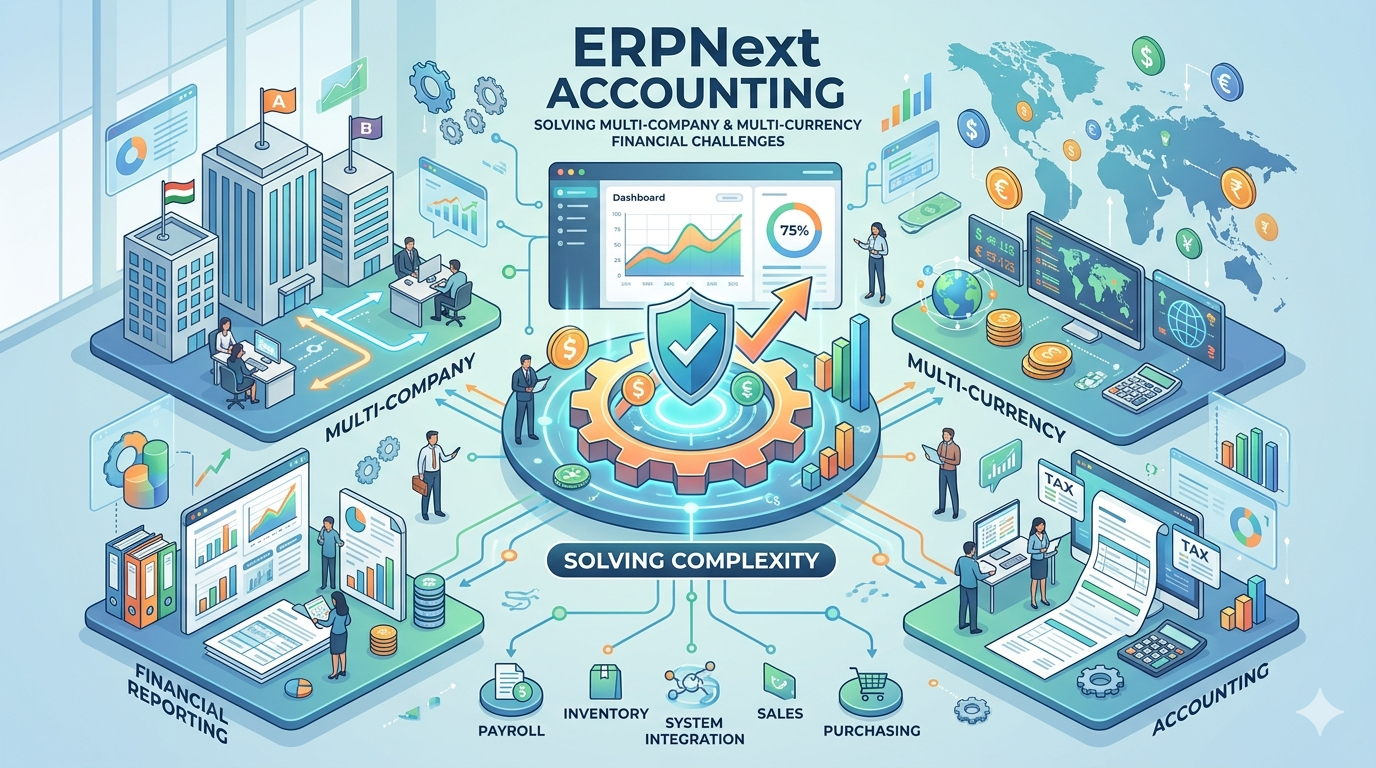
Multi-company accounting
Multi-location operations
Role-based permissions
Workflow automation
Department-wise reporting
Approval hierarchies
This makes ERPNext suitable for businesses planning long-term growth.
Industries That Benefit from ERPNext Accounting
Manufacturing Industry
Track production costs, inventory valuation, and operational expenses from one platform.
Chemical Industry
Manage batch costing, compliance accounting, and purchase tracking more efficiently.
Real Estate Industry
Monitor customer payments, project expenses, and installment tracking in real time.
Distribution Businesses
Handle inventory-linked accounting and supplier management with better visibility.
Signs Your Business Has Outgrown Traditional Accounting Software
Your business may require ERPNext Accounting if:
Financial reporting takes too much time
Teams depend heavily on Excel sheets
Inventory and accounting are disconnected
Manual reconciliation is increasing
Departments work on separate systems
Business visibility is limited
Approval processes are slow
These are common signs that businesses need an integrated ERP solution.
Key Advantages of ERPNext Accounting
Real-Time Data Visibility
Business data updates instantly across departments.
Reduced Manual Work
Automation improves accounting efficiency.
Better Financial Accuracy
Integrated workflows reduce duplicate entries and errors.
Faster Decision-Making
Live reports help management respond quickly.
Improved Compliance
GST, taxation, and audit reporting become easier to manage.
Centralized Operations
All teams work on one connected platform.
Why Businesses Are Moving Toward ERP-Based Accounting
Modern businesses need more than basic accounting software. They require systems that connect finance with operations, inventory, purchasing, and customer management.
ERPNext provides this integrated approach while improving automation, transparency, and reporting efficiency.
Businesses moving toward ERP-based accounting are better prepared for operational growth, financial control, and process standardization.
How Sigzen Helps Businesses Implement ERPNext Accounting
At Sigzen Technologies Pvt. Ltd., businesses receive ERPNext implementation services tailored to their accounting and operational requirements.
The implementation process focuses on:
Understanding current accounting challenges
Mapping finance workflows
Improving reporting visibility
Automating accounting operations
Connecting departments into one ERP system
Frequently Asked Questions (FAQs)
What is ERPNext Accounting?
ERPNext Accounting is an ERP-based finance management system that connects accounting with inventory, sales, purchasing, and business operations.
How is ERPNext different from traditional accounting software?
Traditional accounting software mainly handles bookkeeping and finance activities, while ERPNext integrates accounting with complete business operations.
Why do growing businesses prefer ERPNext Accounting?
Businesses prefer ERPNext because it provides automation, real-time visibility, centralized reporting, and better operational coordination.
Can ERPNext improve financial reporting?
Yes. ERPNext provides real-time financial reports including Profit & Loss, Balance Sheet, Cash Flow, GST reports, and operational analytics.
Is ERPNext suitable for manufacturing and distribution businesses?
Yes. ERPNext is widely used in manufacturing, distribution, chemical, and real estate industries because of its integrated accounting and inventory capabilities.
Does ERPNext reduce manual accounting work?
Yes. ERPNext automates invoicing, journal entries, reconciliation, and workflow approvals, reducing manual dependency.
Conclusion
Traditional accounting software may support basic finance operations, but growing businesses require more connected and scalable systems. As operations expand, disconnected tools create reporting delays, communication gaps, and operational inefficiencies.
ERPNext Accounting helps businesses move beyond standalone finance systems by integrating accounting with complete business operations. With automation, real-time reporting, inventory integration, and centralized visibility, ERPNext provides better financial control for modern B2B organizations.
Businesses looking to improve operational efficiency, automate financial processes, and gain better business visibility should consider moving toward ERP-based accounting solutions.

















Write a comment ...