
The Future of Real Estate: How AI, Automation, and ERP Software Are Driving Unprecedented Growth
The real estate industry, traditionally slow to adopt new technologies, is standing at a digital precipice. The age of sprawling spreadsheets, siloed data, and fragmented communications is ending. We are witnessing a fundamental paradigm shift driven by artificial intelligence (AI) and automation, forcing developers, property managers, and investors to rethink their entire operational models. At the epicenter of this transformation sits ERP software for real estate—the essential digital backbone that unifies these emerging technologies into a powerful engine for scalable growth. For small to mid-sized businesses, this isn't just about efficiency; it's about survival in a rapidly evolving market.
What is the Future of Real Estate Technology?
The Future of Prop Tech is defined by the integration of intelligence into every asset lifecycle stage. The goal is a truly autonomous real estate operation where software not only manages data but generates insights and executes actions.
AI-Powered Predictive Analytics: Algorithms that analyze vast datasets (demographics, market trends, local development) to predict future property values and rental yields with high accuracy.
End-to-End Workflow Automation: A single ecosystem where a tenant's maintenance request automatically triggers a work order, assigns a vendor, notifies the super, and updates the financial ledger without human intervention.
Unified Digital Ecosystems: The demise of point solutions; a successful future real estate firm operates on one centralized platform, connecting sales, leasing, finance, and maintenance.
The Role of AI in Real Estate ERP Systems
While generic AI is powerful, its true value is realized when embedded deeply within operational workflows. ERP real estate software is increasingly incorporating these capabilities.
1. Advanced Demand Forecasting
AI changes property development from reactive to proactive.
Intelligent Market Analysis: ERPs with built-in AI can ingest third-party market data to advise developers on what to build (e.g., luxury condos vs. workforce housing) and when to break ground.
Risk Mitigation: By identifying patterns in construction delays, cost overruns, and supply chain fluctuations, AI allows managers to preemptively address project risks.
2. Hyper-Personalized Customer Experiences
In leasing and sales, personalization is the new competitive battleground.
AI Chatbots & Virtual Assistants: Integrated CRM modules in real estate ERPs use AI to engage leads 24/7, qualify potential tenants, and even schedule viewings, ensuring no lead is lost.
Predictive Maintenance for Tenants: AI analyzes sensor data from IoT devices to predict when an HVAC system might fail, scheduling repairs before the tenant notices a problem.
Why Automation is Essential for Industry Growth
Automation is the engine that converts data into speed and efficiency. It allows real estate firms to scale their portfolios significantly without a linear increase in administrative headcount.
1. Eliminating Operational Friction
Every manual process is a bottleneck. Automation dissolves them.
Automated Lease Administration: Generate contracts, send renewal notices, and apply rent escalations automatically based on predefined rules in your real estate management erp.
Instant Financial Consolidation: For companies with multiple properties (SPVs), automation aggregates financial data instantly, providing a real-time view of cash flow and portfolio performance.
2. Cost Reduction and Enhanced Margins
Efficiency directly correlates to profitability in a low-margin environment.
Optimized Energy Management: Automated systems (integrated via ERP) can adjust lighting and HVAC based on occupancy patterns, drastically reducing utility costs.
Faster "Lease-Up" Times: Automated screening and onboarding processes significantly reduce the time a unit sits vacant, maximizing rental revenue.
Leveraging Open Source: ERPNext Real Estate
For small to mid-sized businesses (SMBs), the barrier to complex ERP systems has traditionally been cost and rigidity. This is where open-source solutions are disrupting the market.
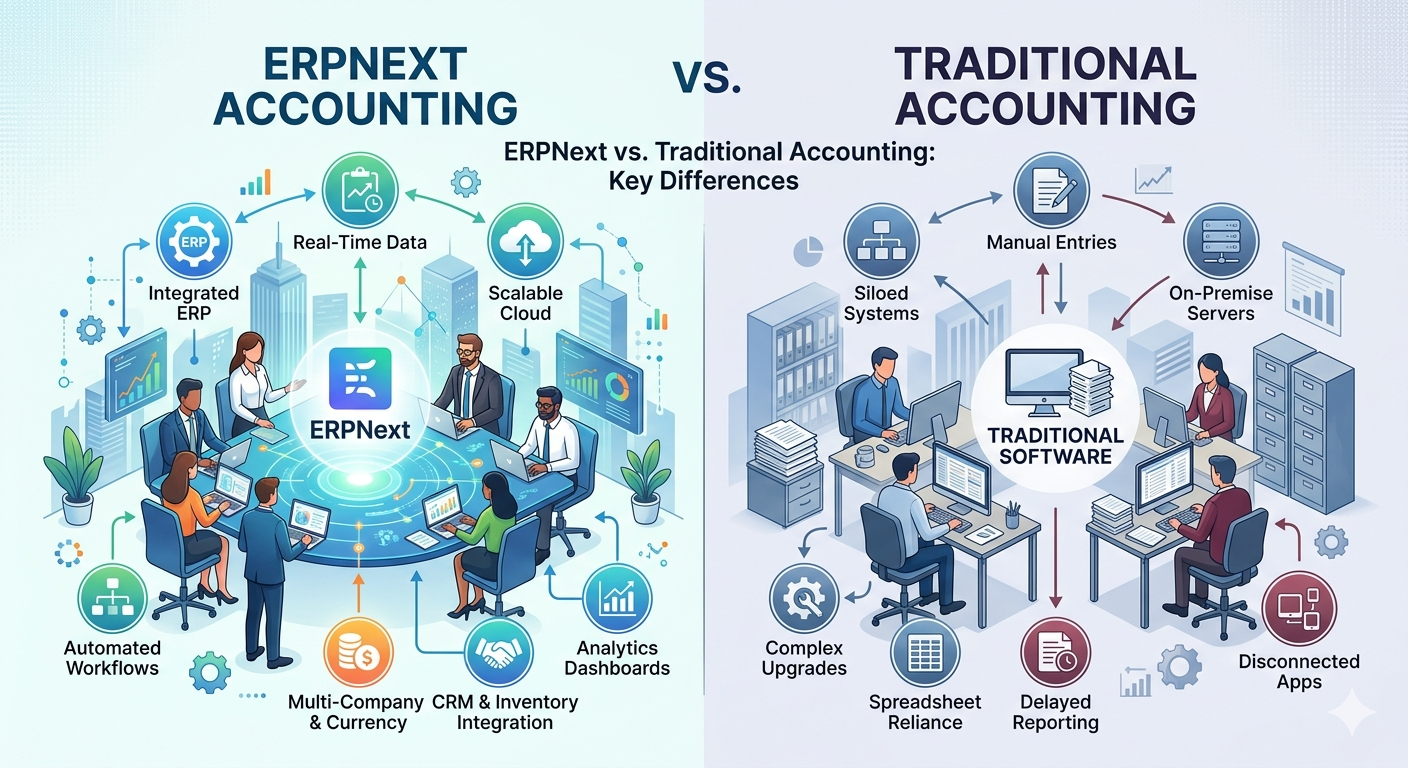
ERPNext real estate provides a powerful, flexible alternative to bloated, legacy systems. It offers a modular architecture that SMBs can scale at their own pace.
Modular Architecture: Start with accounting and CRM, then easily add property management or construction modules as your business grows.
Lower Total Cost of Ownership (TCO): Eliminate license fees and invest that capital into custom automation workflows or AI integrations that differentiate your service.
Rapid Community-Driven Innovation: Benefit from new features and integrations developed by a global community focused on modern business challenges.
Frequently Asked Questions (FAQs)
What is the difference between property management software and real estate ERP?
Property management software usually focuses on operational tasks like leasing and maintenance. Real Estate Management ERP is a broader ecosystem that integrates those operations with financial accounting, HR, CRM, project management, and reporting, providing a 360-degree view of the business.
How does AI improve property valuation?
AI utilizes machine learning models that process much more than just recent sales data . It analyzes hundreds of variables, including hyper-local amenities, crime statistics, planned infrastructure projects, and macroeconomic trends, to generate dynamic, predictive valuations.
Can a small real estate business afford an ERP with AI capabilities?
Yes, especially by utilizing modern, open-source platforms like ERPNext Real Estate. The modular nature and lack of license fees allow SMBs to implement sophisticated automation and eventually integrate AI features at a fraction of the cost of traditional enterprise software.
What is the first step in automating real estate operations?
The first step is always data consolidation. Before you can automate, you must move away from scattered spreadsheets and siloed apps into a centralized system like ERP real estate software. Clean, accessible data is the prerequisite for all automation and AI.
Is AI going to replace real estate agents?
No. AI will replace the tedious, administrative tasks agents perform , freeing them to focus on high-value activities like negotiation, relationship building, and strategic advisory roles where human judgment is irreplaceable.
Conclusion: Seizing the Future of Real Estate
The real estate industry is moving toward a future that is predictive, automated, and hyper-efficient. Companies that continue to operate in silos will find themselves unable to compete with the speed and intelligence of AI-powered firms. Implementing a robust ERP software for real estate is not a technological luxury; it is the foundational strategic decision that unlocks this future. Whether you select an open-source solution like ERPNext Real Estate or a specialized system, the goal is the same: unified data and intelligent operations that drive sustainable growth.

















Write a comment ...